
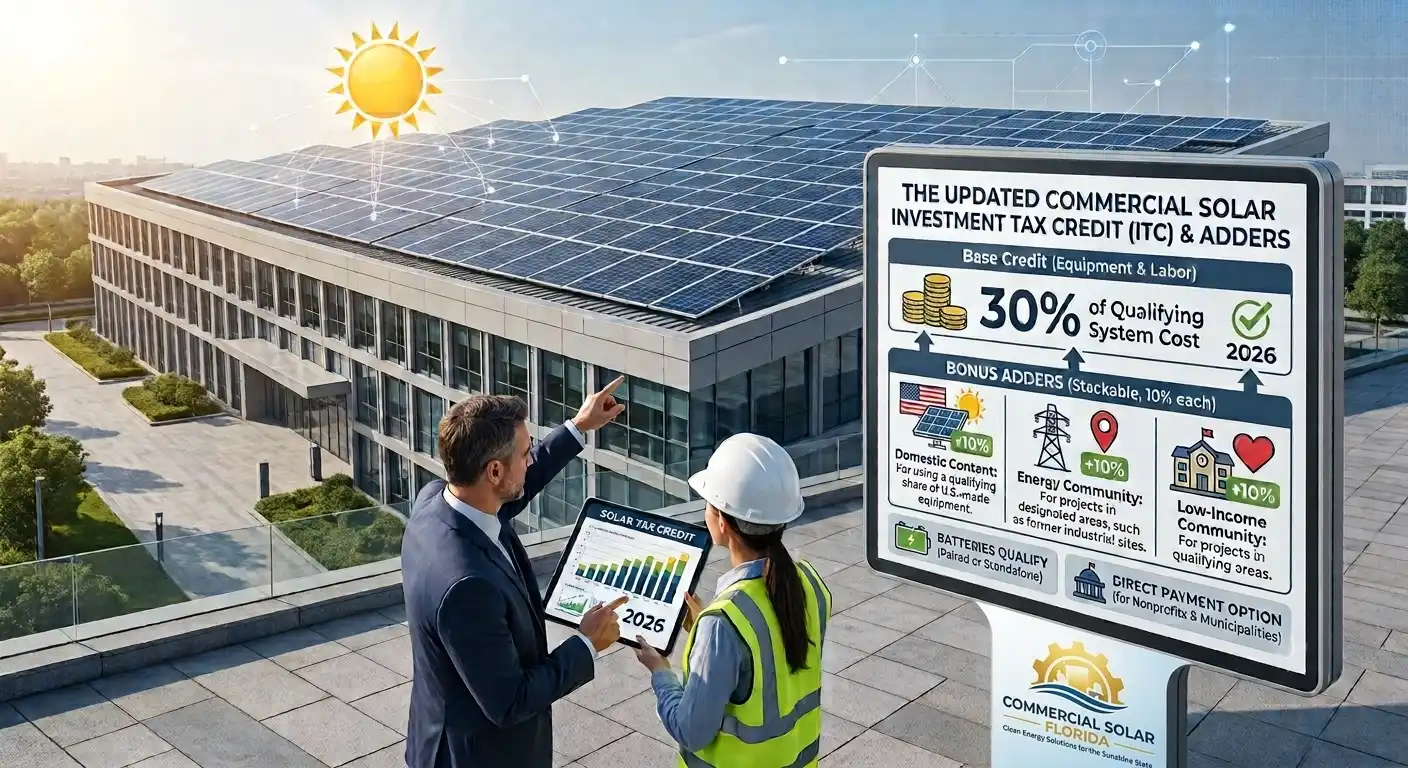
The commercial credit is still here
While the residential credit expired at the end of 2025, the commercial Investment Tax Credit (ITC) for solar is still in force. The base credit is 30% of a qualifying system's cost, covering both equipment and labor. From there, bonus adders can stack on top, each worth an additional 10% of the system cost.
Domestic content
For using a qualifying share of U.S.-made equipment.
Energy community
For projects in designated areas, such as former industrial sites.
Low-income community
For projects in qualifying areas.
A project that meets one or more of these can move the federal credit well past 30%. Batteries qualify too, whether paired with solar or installed on their own, and tax-exempt organizations such as nonprofits and municipalities can now receive the credit as a direct payment rather than a tax offset.
How accelerated depreciation works
The credit is only half the story. Solar equipment is treated as 5-year MACRS property under the Modified Accelerated Cost Recovery System, so its cost is recovered over roughly six tax years on an accelerated schedule that front-loads the deductions into the early years of ownership.
There is one wrinkle worth understanding. When you claim the 30% ITC, your depreciable basis is reduced by half the credit amount, which leaves about 85% of the system's cost available to depreciate. On top of that, 100% bonus depreciation may apply, allowing the entire depreciable amount to be deducted in a single year rather than spread across the schedule.
What the math looks like
An illustrative $500,000 commercial installation:
- • The 30% ITC recovers about $150,000.
- • First-year depreciation adds tens of thousands more in deductions.
- • After both, the net cost often lands around 45% to 55% of the sticker price, roughly $225,000 to $275,000 in combined tax benefits.
Your actual result depends on your business's tax position. Treat these figures as a model, not a promise, and confirm them with your tax advisor.
Who this is a fit for
Commercial solar makes the most sense for Orlando businesses with meaningful daytime electricity use and enough roof, land, or parking area to host an array: manufacturing and warehousing, agriculture, retail centers, medical and office buildings, and similar. With Duke Energy and Orlando Utilities Commission (OUC) rates climbing, locking in your energy cost protects your margins for decades.
Why timing matters
Federal clean-energy incentives are on a phase-down path, and the rules carry specific deadlines tied to when a project begins construction and when it is placed in service. Those details are involved and changing, so the safe assumption is that today's benefit will not be there indefinitely. If solar is on your radar, 2026 is the year to map out your timeline while the full benefit is on the table.